
AI Hacking Night with the Deacons
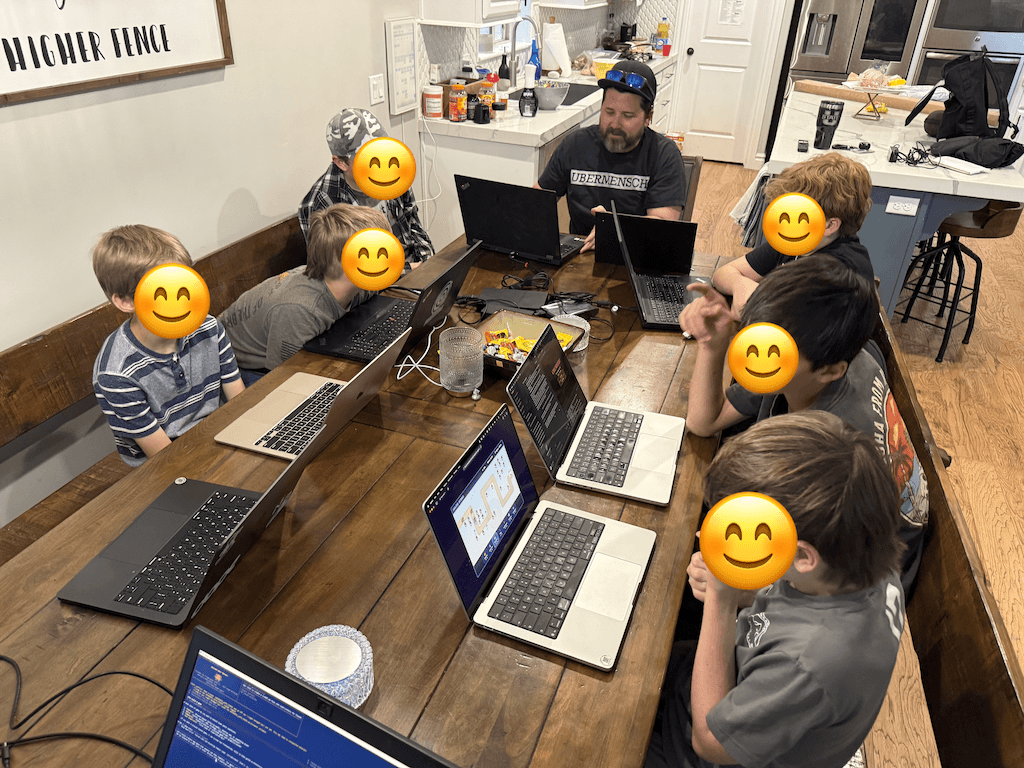
A few weeks ago, I ran an AI hacking night with our church youth group. Six 12-year-old boys. Zero coding experience. Each kid built a real, playable video game.
Not a tutorial. Not a worksheet. They built Guitar Slash, Igloo Siege, Knight Fury, Star Blaster, and Indiana Jones and the Run. Some of these games are over a thousand lines of JavaScript. You can play them right now: https://deacons-mini-games.kevintame.co
Here's how it worked.
I built a game-design-partner agent. It's a prompt layer on top of Claude Code that turns the AI into a game design partner for kids. It walks them through three phases: brainstorm your idea, build it in vanilla HTML and JavaScript, then push it to a shared repo. The tone is set to "enthusiastic older friend." It keeps scope tight (no multiplayer, no 3D, no servers) and explains what it's doing in language a 12-year-old can follow.
Each kid sat down, described the game they wanted to make, and started building. The AI asked them questions. What's the core mechanic? What makes it fun? What should we call it? Then it wrote the code while narrating what it was doing and why. The kids made decisions the whole time. The AI just made those decisions real, fast.
You could feel the energy in the room. Kids were hyper focused on their work, they crowded around each other's screens, they were talking about each other's games, and going back to tweak things. One kid redesigned his entire jumping mechanic because he played it and thought it was too hard. Another added a combo system because he wanted his game to feel more intense. The focus was genuine. Nobody was checking out or waiting for it to be over. They were locked in.
That's not passive consumption. That's creation.
Daniel Pink talks about three drivers of real motivation in his book Drive: autonomy, mastery, and purpose. This hit all three. The kids had full autonomy over what they built. They experienced mastery through rapid iteration, building something, playing it, and making it better in minutes. And they had purpose because their games were going on a real site that their friends and family could play.
Nobody had to convince them to pay attention. Nobody had to manage behavior. It was supposed to be a one-hour activity. An hour in, nobody wanted to stop. We kept going for another 30 minutes and even then it was hard to pull them away. We ended up kicking them out because we had other commitments. Next time we're making it a longer block.
The barrier to creation just dropped to zero. A 12-year-old with an idea and an AI partner can ship a real game in an evening. That changes everything about how we think about learning, engagement, and what kids are capable of.
The game-design-partner prompt and all five games are here: https://github.com/kevintame/deacons-mini-games
You can play them in a browser here: https://deacons-mini-games.kevintame.co/